

What is endovascular aneurysm coiling?
Coiling treats a brain aneurysm from inside the artery, without opening the skull. Soft platinum coils fill the aneurysm so that blood no longer flows into it, reducing the risk of bleeding or re-bleeding.
Suspected stroke? Call 108 now. Don’t wait for an appointment.
Call 108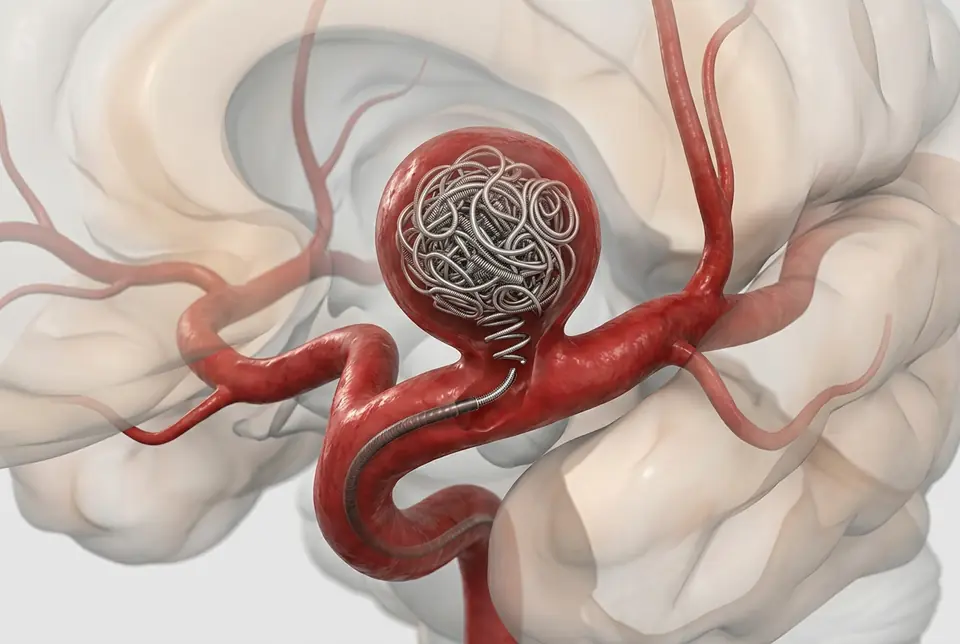
Stroke & Neurointervention
A minimally invasive treatment that fills a suitable brain aneurysm with soft coils, placed from inside the blood vessels.
Coiling treats a brain aneurysm from inside the artery, without opening the skull. Soft platinum coils fill the aneurysm so that blood no longer flows into it, reducing the risk of bleeding or re-bleeding.
A microcatheter, a very thin tube, is guided through the arteries into the aneurysm under X-ray imaging. Coils are placed one by one until the aneurysm is filled. Blood then clots around the coils, sealing the aneurysm off from circulation.
 Clip · 66s
How coils are placed inside an aneurysm through the blood vessels to seal it off.
Suitability depends on the aneurysm’s anatomy, such as its size, shape, location and the width of its neck, and on clinical factors including whether it has bled and the patient’s overall health. Wide-necked aneurysms may need a stent or balloon to help hold the coils in place.
Coiling is usually done under general anaesthesia in an angiography suite. Access is through an artery at the groin or wrist, and the coils are placed under continuous X-ray guidance.
Patients are monitored in hospital after the procedure. Follow-up imaging, usually MRA or DSA, checks that the aneurysm remains sealed, at intervals advised by the treating team.
Coiling, flow diversion and surgical clipping each suit different aneurysms. The choice depends on the aneurysm, whether it has bled and the patient’s health and preferences, and is made individually after discussion.
Flow-diverter treatmentOpen Mon–Sat, 9AM–5PM
Consultations are at KIMS Hospitals (New Facility), Kondapur, Hyderabad. Bring your CT, MRI or angiography reports and images. A sudden, severe headache is an emergency: call 108 or go to the nearest emergency department.
Choose a day from Monday to Saturday. The clinic calls back to confirm your time.
Request appointment