

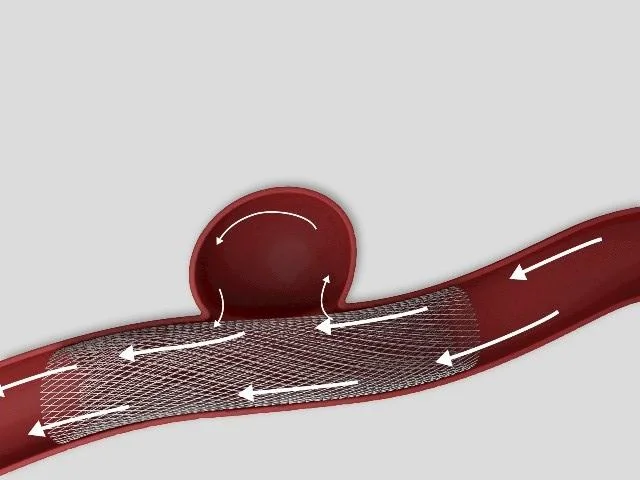
A flow diverter is a fine, flexible mesh tube (a type of stent) placed inside a brain artery, across the opening (“neck”) of an aneurysm. It is used to treat selected brain aneurysms from inside the blood vessels, without opening the skull.
How does it work?
The mesh of a flow diverter is much denser than an ordinary stent. Once in place, it guides most of the blood along the main artery instead of into the aneurysm. Blood inside the aneurysm slows down and gradually clots, and over the following weeks to months the lining of the artery grows over the mesh, sealing the aneurysm off.
Unlike coiling, which fills the aneurysm straight away, a flow diverter works gradually. Follow-up scans show whether the aneurysm has closed.
Which aneurysms may be considered?
Flow diversion may be considered for some unruptured aneurysms, such as large aneurysms, aneurysms with a wide neck, and some that are difficult to treat with coiling alone. It is not suitable for every aneurysm. The choice depends on the aneurysm’s size, shape and location, the arteries around it and the patient’s overall health, and is made after detailed imaging such as cerebral angiography (DSA).
Why are blood-thinning medicines needed?
A flow diverter is a foreign material inside the artery, so patients take antiplatelet medicines before and for a period after the procedure to stop clots forming on it. Taking them exactly as prescribed is very important. Do not stop or change them without speaking to the treating team, including before dental work or any other surgery.
What are the risks?
Risks include a stroke from a clot forming on the device or blocking a nearby branch artery, bleeding (including from the antiplatelet medicines), injury to the artery, problems at the puncture site and reactions to the contrast dye. Not every aneurysm closes completely, and some patients need further treatment. Your specialist will explain how these risks apply to you.
What happens afterwards?
Most patients stay in hospital for a short time for monitoring. Follow-up imaging is arranged over the following months to check that the aneurysm is closing and the artery remains open, and the antiplatelet plan is reviewed at each visit.
Related pages
References
This article is general information, not a diagnosis. For a suspected stroke or other emergency, call 108 or go to the nearest emergency department.